
In commercial buildings, HVAC systems typically account for 40-60% of total energy consumption, and a significant portion of that energy is wasted through inefficient flow control. Traditional HVAC valves often operate inefficiently under partial loads, causing high energy consumption and inconsistent room temperatures . As building owners face mounting pressure to reduce operational costs and meet sustainability targets, the compact electric modulating valve has emerged as a proven solution that delivers measurable energy savings, precise control, and reliable performance in space-constrained mechanical rooms.
This post explores how BESTONE compact electric modulating valves are addressing the energy efficiency challenge in HVAC applications, examines the engineering principles that enable significant energy reduction, and highlights why our long-life, compact design valves are the preferred choice for building automation professionals.
TL;DR Key Takeaways for HVAC & Building Automation Professionals
1. The Energy Challenge: HVAC systems consume 40-60% of building energy. Inefficient valve control under partial loads is a primary source of waste traditional valves often lack the precision needed for optimal operation.
2. The Compact Solution: BESTONE compact electric modulating valves combine pressure-independent control, full 0-100% modulating capability, and high-resolution positioning (up to ±0.5% accuracy) to deliver precise flow matching actual load requirements eliminating energy waste .
3. Smart Energy Features: Integrated solutions can reduce HVAC energy consumption by up to 25% through dynamic balancing, delta-T optimization, and real-time flow measurement . Cloud-based energy monitoring and self-optimizing intelligence are increasingly available .
4. Space-Saving Design: Compact valve bodies (DN10-DN50) and direct-coupled actuators reduce installation footprint, simplify retrofits, and lower total installed cost .
5. BESTONE Advantage: Our compact electric modulating valves deliver exceptional durability (100,000+ cycles), precision control, and comprehensive technical support helping building owners achieve energy savings, occupant comfort, and regulatory compliance.
Why HVAC Systems Waste Energy—And How Compact Electric Valves Solve the Problem
The Hidden Cost of Inefficient Flow Control
Most HVAC systems operate under partial load conditions for the majority of the year. Yet traditional on/off valves or poorly-sized control valves struggle to modulate flow accurately at low loads resulting in:
- Overcooling or overheating spaces, wasting energy and reducing comfort
- Pump energy waste from unnecessarily high flow rates and pressure
- Reduced chiller/boiler efficiency when return water temperatures are not optimized
- Frequent valve cycling that shortens equipment life
How Compact Electric Modulating Valves Deliver Energy Savings
A pressure-independent compact electric modulating valve (PICV) solves these problems through three integrated functions :
| Function | How It Works | Energy Benefit |
| Dynamic Balancing | Built-in differential pressure regulator maintains stable flow regardless of system pressure fluctuations | Eliminates overflow, reduces pump energy |
| Full Modulating Control | 0-10V or 4-20mA signal enables precise, proportional valve positioning | Flow exactly matches load—no waste |
| Compact Integrated Design | Three functions in one valve body—no external balancing valves needed | Lower system resistance, smaller footprint |
The result: Flow is automatically regulated to exactly what the load requires, no more, no less. This reduces pump energy consumption, improves chiller/boiler efficiency, and maintains consistent space temperatures.
Quantifying the Savings
Industry data shows that intelligent, pressure-independent valves can reduce HVAC energy consumption by up to 25% compared to traditional control valves . The savings come from:
- Reduced pump operation (lower flow rates mean less pumping energy)
- Improved delta-T (return water closer to design temperature, improving chiller efficiency)
- Elimination of overflow (no wasted chilled/heated water bypassing the load) “Through faster response, increased system stability, and lower pump pressures, Frese OPTIMA Compact achieves higher delta-T operation and significant energy savings”
Key Applications in HVAC Systems
Air Handling Units (AHUs)
AHUs require precise chilled and hot water flow control to maintain supply air temperature setpoints. BESTONE compact modulating valves provide:
- ±0.5% position accuracy for consistent temperature control
- Rapid response to load changes (adjustable response time <0.5 seconds)
- Integration with DDC controllers via Modbus or 0-10V signals
Fan Coil Units (FCUs)
FCUs are space-constrained terminal units where compact valve size is critical. BESTONE DN10-DN50 compact valves feature:
- Reduced installation footprint—ideal for tight FCU enclosures
- Low pressure drop—minimizes pump energy
- Simple commissioning with pre-set flow options
Chilled Water Systems
Building chilled water distribution networks require balancing and control across multiple zones. BESTONE valves with digital communication (Modbus RTU, BACnet) enable:
- Centralized monitoring of flow and energy consumption
- Remote setpoint adjustment without physical access
- BMS integration for system-wide optimization
Heat Exchangers and Mixing Loops
Heat exchangers serve as the interface between primary and secondary systems. BESTONE valves with high turndown ratios (100:1 or greater) deliver precise control across wide flow ranges, ensuring:
- Accurate secondary temperature control
- Stable operation under varying loads
- Protection against thermal shock from sudden flow changes
Engineering Design: What Makes a Compact Electric Modulating Valve Energy-Efficient
1. Dynamic Balancing and Pressure Independence
Traditional control valves are pressure-dependent—when system pressure changes (due to other valves opening/closing), flow through the valve changes unpredictably. A pressure-independent compact valve uses an integrated differential pressure regulator to maintain constant flow for any given valve position .
This means:
- 100% valve authority—the valve has full control over flow
- No overflow—even under varying system pressures
- Stable control loops—no hunting or oscillation
2. High-Resolution Modulating Actuators
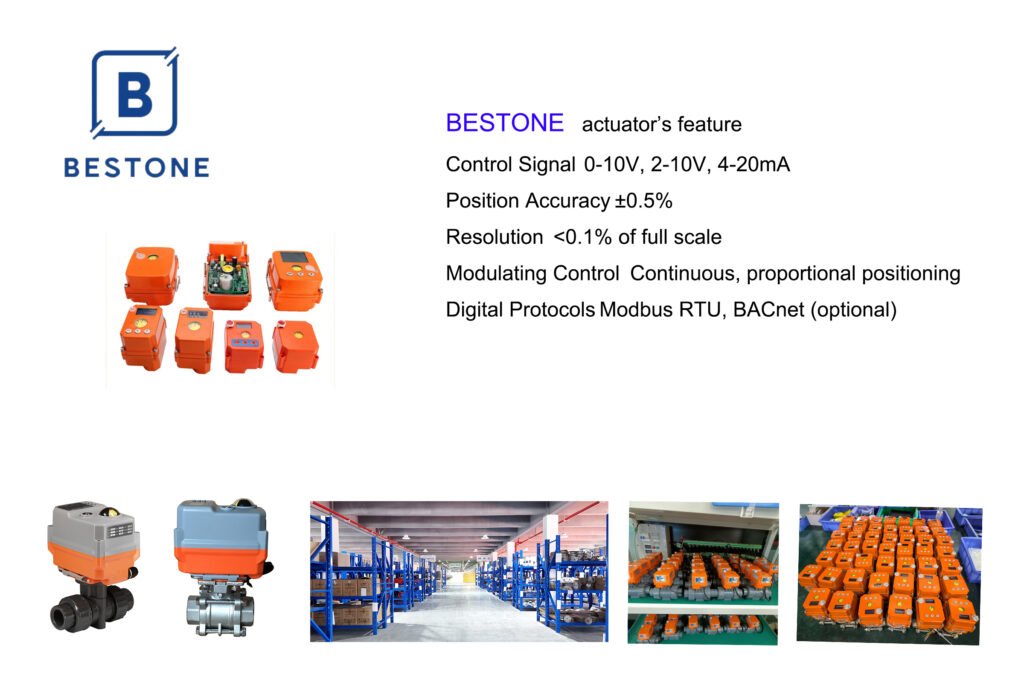
BESTONE actuators for compact modulating valves deliver:
| Parameter | Specification |
| Control Signal | 0-10V, 2-10V, 4-20mA |
| Position Accuracy | ±0.5% |
| Resolution | <0.1% of full scale |
| Modulating Control | Continuous, proportional positioning |
| Digital Protocols | Modbus RTU, BACnet (optional) |
This precision enables fine-tuned flow control at low loads where energy waste is most common .
3. Compact Design with Full Functionality
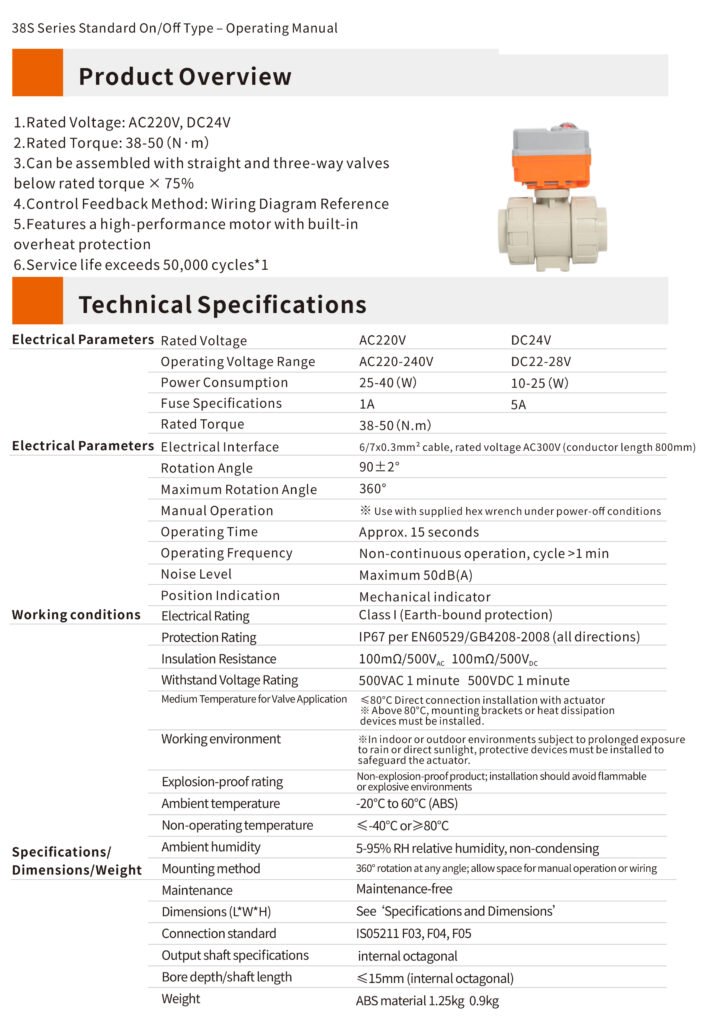
The “compact” advantage is more than just space-saving. BESTONE valves integrate multiple functions (control, balancing, shut-off) into a single, compact body, delivering:
- Fewer components—reduced installed cost and fewer potential leak points
- Lower system resistance—saves pump energy
- Smaller mechanical rooms—more usable building space
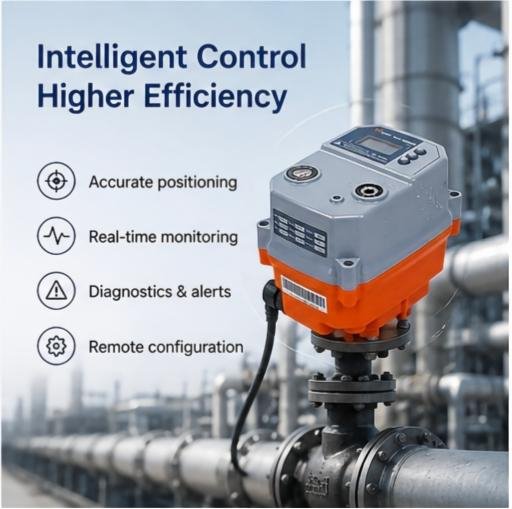
4. Digital Intelligence and Self-Optimization
Modern compact electric valves increasingly incorporate smart functionality:
- Flow measurement—built-in sensors measure actual flow in real time
- Delta-T optimization—automatically adjusts flow to achieve optimal return water temperature
- Cloud-based monitoring—track energy performance and receive predictive maintenance alerts
- Self-balancing—automatically balances the system without complex calculations.
“The Intelligent Valve, with its adaptive flow optimizer, measures flow rate, temperature, position and power. It dynamically balances pressure fluctuations and adjusts volumetric flow for delta-T, reducing energy consumption.” — Siemens
Comparison: Compact Electric Modulating Valve vs. Alternatives
For building owners and HVAC engineers, the choice of control valve significantly impacts energy performance and total cost of ownership.
| Feature | BESTONE Compact Electric Modulating Valve | Traditional Globe Control Valve | On/Off Ball Valve | Manual Balancing Valve |
| Flow Characteristic | Equal % / Linear | Equal % | On-off only | Fixed setting |
| Pressure Independence | Yes (built-in regulator) | No | No | No |
| Modulating Control | 0-100% continuous | 0-100% continuous | No | No |
| Valve Authority | 100% | 30-50% | N/A | N/A |
| Energy Waste | Minimized | Significant | Very high | High |
| Installed Footprint | Compact (all-in-one) | Large (valve + accessories) | Moderate | Moderate |
| Commissioning Effort | Low (auto-balancing) | High (manual balancing) | Low | Very high |
| BMS Integration | Yes (digital) | Yes | Yes | No |
| Total Cost of Ownership | Low | High | Moderate | High |
For energy-efficient HVAC systems, the compact electric modulating valve offers clear advantages—particularly in reduced pump energy, lower installed costs, and simplified commissioning .
Market Trends Driving Adoption
1. Building Energy Regulations
The European Union’s Energy Performance of Buildings Directive (EPBD) and similar regulations worldwide require continuous energy monitoring and system optimization. Smart valves with built-in energy measurement and reporting help building owners comply with these requirements .
2. Demand for Retrofit Solutions
Aging building stock represents a massive opportunity for energy savings. Compact valves with standard face-to-face dimensions (EN 558) enable easy replacement of existing valves during refurbishment, making energy-efficient retrofits practical and cost-effective .
3. Digitalization and IoT
Building automation systems increasingly demand real-time data from field devices. Valves with digital communication (Modbus, BACnet) provide:
- Live flow and energy data for dashboard visualization
- Predictive maintenance alerts to prevent failures
- Historical data for performance verification and ESG reporting
4. Space Optimization
Mechanical room space is at a premium in commercial buildings. Compact valve designs enable:
5. Sustainability and ESG Goals
Corporate sustainability targets are driving investment in energy efficiency. Valves that deliver verifiable energy savings help building owners:
- Reduce carbon footprint
- Meet ESG reporting requirements
- Achieve green building certifications (LEED, BREEAM)
Selection Guide: Choosing the Right Compact Electric Modulating Valve
When specifying compact electric modulating valves for HVAC applications, consider the following factors:
Step 1: Define System Requirements
| Parameter | Questions to Ask |
| Flow Rate | Design flow at full load? Minimum flow at partial load? |
| System Pressure | Available pressure at the valve? Maximum system pressure? |
| Pressure Fluctuations | How much does system pressure vary under different loads? |
| Control Signal | 0-10V, 2-10V, 4-20mA, or digital protocol? |
| BMS Requirements | Need Modbus, BACnet, or other integration? |
| Space Constraints | Available installation space? |
Step 2: Select Valve Size and Cv
Use the valve Cv table to select the correct size. For HVAC applications, avoid oversizing—a valve that operates at 20-80% of its full opening range provides the best control.
Step 3: Choose Configuration
| Feature | Options | Best For |
| Actuator Type | 2-position (on/off), 3-point floating, or modulating 0-10V | Modulating for energy efficiency |
| Fail-Safe | Spring-return (normally open/closed), SuperCapacitor backup | Critical cooling/heating applications |
| Communication | Analog (0-10V, 4-20mA), Modbus, BACnet | BMS integration |
| Body Material | Brass, bronze, stainless steel | Media compatibility |
Step 4: Plan for Commissioning and Maintenance
- Auto-balancing features reduce commissioning time
- Removable cartridges simplify flushing and maintenance
- Remote configuration via mobile app or BMS saves on-site visits
Why Choose BESTONE Compact Electric Modulating Valves?
With over 30 years of manufacturing experience and a 50,000-square-meter production facility, BESTONE delivers the quality and reliability that building automation professionals demand .
Exceptional Precision and Control
BESTONE compact modulating valves deliver the accuracy that energy-efficient HVAC systems require:
- ±0.5% position accuracy for consistent, stable control
- 100% valve authority for reliable flow regulation
- Adjustable response time for optimal system dynamics
Engineered for Long Life
HVAC systems operate continuously. BESTONE valves are engineered for endurance:
- 100,000+ cycle life—designed for maintenance-free operation
- Durable materials—brass, bronze, and stainless steel options
- Rigorous testing—every valve is performance-verified before shipment
Compact, Space-Saving Design
BESTONE valves feature a compact, modular design that:
- Reduces installation footprint
- Simplifies maintenance access
- Fits in tight mechanical rooms and FCU enclosures
Comprehensive Technical Support
From sizing through commissioning, BESTONE’s engineering team provides:
- Flow and Cv calculations
- BMS integration support
- Troubleshooting and maintenance guidance
- Application-specific recommendations
Proven Track Record
BESTONE products have been widely applied in national key projects including:
- China Museum central air-conditioning system
- Guangzhou wastewater treatment projects
- Shanghai International Airport
- Qinshan Nuclear Power Station
Conclusion
As building owners and facility managers face increasing pressure to reduce energy consumption and operational costs, compact electric modulating valves have emerged as a proven, cost-effective solution. By delivering precise flow control, dynamic balancing, and intelligent energy optimization, these valves can reduce HVAC energy consumption by up to 25% while improving occupant comfort and simplifying system commissioning.
Whether you are designing a new building, retrofitting an existing HVAC system, or upgrading terminal units, BESTONE compact electric modulating valves deliver:
- Measurable energy savings—through precise, pressure-independent flow control
- Reduced operational costs—lower pump energy, less maintenance
- Simplified installation—compact footprint, auto-balancing
- BMS integration—digital communication for real-time monitoring
- Long-term reliability—100,000+ cycle design, quality manufacturing
With BESTONE’s engineering expertise, compact designs, and comprehensive technical support, you can achieve your building energy efficiency goals while maintaining the comfort and reliability that building occupants expect.